


Exposed bulbs with visible glowing threads add timeless warmth to modern homes, whether installed in rustic sconces or kitchen pendants. Many homeowners admiring this vintage style wonder who invented the filament light bulb and how those early glass designs paved the way for current home fixtures. Early experimental designs began in laboratory workshops during the nineteenth century before electrical distribution systems ever reached residential neighborhoods. Anyone planning new fixture layouts, such as homeowners learning how to hang pendant lights, can appreciate the long transition from delicate carbon threads to modern clear glass illumination.
The practical answer to who invented the filament light bulb involves a collaborative chain of global inventors rather than a single breakthrough moment. Pioneers like Humphry Davy, Warren de la Rue, Joseph Swan, and Thomas Edison each solved crucial hurdles regarding vacuum glass bulbs and heat resistance. Modern shoppers can now enjoy vintage aesthetics paired with efficient micro-LED conductors that produce soft warmth without excessive energy consumption. Understanding the mechanical lineage of incandescent filaments helps buyers evaluate modern clear bulb options, color temperatures, and socket compatibility for everyday residential lighting.


The Evolution of the Filament Light Bulb: From 19th-Century Innovation to Modern LED Aesthetics
Understanding who invented the filament light bulb requires looking beyond the popular legend of a single solitary inventor. More than twenty different scientists and experimenters across Europe and North America developed working incandescent designs throughout the nineteenth century. Thomas Edison earned widespread commercial fame because he developed an entire integrated electrical supply system alongside a durable carbonized filament. Modern consumers now benefit directly from this innovation through clear glass LED filament bulbs that replicate historic warmth while using fraction of the electrical power.
The Early Innovators Who Pioneered Incandescent Lighting
Humphry Davy initiated the fundamental science of electric illumination in 1802 by passing current through thin strips of platinum. Platinum possessed an exceptionally high melting point, but the metal degraded rapidly when exposed to open atmospheric oxygen. Scientists soon realized that sustained incandescent light required placing the glowing conductor inside a sealed, airless glass container. Vacuum pump technology in the early nineteenth century remained rudimentary, which severely limited how long early experimental filaments could glow.
British scientist Warren de la Rue made a notable breakthrough in 1840 by enclosing a coiled platinum filament inside an evacuated glass tube. The vacuum slowed chemical oxidation, allowing the filament to produce light without immediately burning away into ash. The extreme cost of refined platinum prevented de la Rue from commercializing his device for ordinary residential lighting. Other experimenters, including James Bowman Lindsay and Marcellin Jobard, tested carbonized conductors during the 1830s and 1840s with varying degrees of success.
These early experiments established two clear mechanical prerequisites for practical incandescent illumination. First, inventors needed a filament material with a high melting temperature and suitable electrical resistance. Second, glassmakers needed high-efficiency vacuum pumps capable of evacuating virtually all air from the glass bulb. Without high vacuum levels, thermal combustion consumed the filament wire within minutes of receiving an electric charge.
Joseph Swan and Thomas Edison: The Race for Practical Illumination
English chemist Joseph Swan developed working incandescent bulbs using carbonized paper filaments during the 1850s and 1870s. Swan demonstrated a functional electric lamp at Newcastle upon Tyne in early 1879, prior to Edison’s public presentations. Early versions suffered from poor vacuum seals and thick carbon rods that required heavy electrical currents. Swan later refined his process by using parchmentized cellulose thread, which yielded significantly thinner filaments and longer operating lifespans.
Thomas Edison approached the challenge at his Menlo Park laboratory by focusing on high electrical resistance and commercial viability. Higher electrical resistance meant a bulb could operate using lower electrical currents, which made widespread municipal power distribution economically feasible. Edison’s research team systematically tested thousands of organic fibers before patenting a carbonized cotton thread filament in late 1879. The team subsequently discovered that carbonized Japanese bamboo filaments could illuminate rooms reliably for hundreds of hours.
Legal disputes over patent priority quickly emerged between Edison and Swan in the United Kingdom. Swan held strong patent rights in Britain, while Edison commanded extensive manufacturing resources and overseas patents. The two rivals chose commercial cooperation over endless litigation by forming the Edison and Swan United Electric Light Company, commonly known as Ediswan. This transatlantic partnership unified their technological patents and accelerated the adoption of carbon filament lighting across municipal buildings and homes.
Lewis Latimer and the Breakthrough in Long-Lasting Carbon Filaments
African American inventor and engineer Lewis Latimer solved the critical durability bottleneck that plagued early commercial incandescent lamps. Early carbonized filaments were fragile, brittle, and prone to breaking during standard handling or regular electrical heating cycles. Latimer worked alongside inventor Hiram Maxim at the United States Electric Lighting Company to engineer a superior manufacturing technique. His patented method enclosed carbon filaments inside cardboard envelopes during the baking process, preventing premature degradation.
Latimer received United States patent number 252,386 in 1882 for this innovative carbon filament production method. His manufacturing process allowed carbon filaments to burn longer, withstand physical vibrations, and maintain consistent light output. The increased durability substantially reduced bulb manufacturing costs and made electric lighting practical for everyday consumer spaces. Latimer subsequently supervised the installation of public electric lighting systems across major cities, including New York, Philadelphia, and London.
Latimer also authored one of the earliest technical handbooks on incandescent electric lighting systems in 1890. His technical leadership helped standardize socket connections, wire routing, and fixture assembly practices across the emerging industry. Without Latimer’s manufacturing improvements, early incandescent bulbs would have remained an expensive laboratory novelty rather than an accessible domestic utility. His engineering contributions remain fundamental to the history of domestic electric lighting.
From Carbon to Tungsten: The Transition to High-Efficiency Metal Wires
Carbon filaments dominated residential lighting through the end of the nineteenth century, but they carried distinct physical drawbacks. Hot carbon slowly evaporated during operation, depositing a dark sooty film on the inner surface of the clear glass bulb. This internal blackening gradually reduced light transmission while thinning the filament wire until it burned out. Lighting engineers searched for durable refractory metals capable of operating at higher temperatures without rapid vaporization.
Russian inventor Alexander Lodygin patented incandescent lamps utilizing tungsten and molybdenum filaments in the 1890s. Early tungsten filaments were produced through chemical pressing processes that yielded brittle metal wires prone to shattering. In 1910, American chemical engineer William Coolidge developed a process at General Electric to manufacture ductile tungsten wire. Coolidge pulled heated tungsten through specialized dies, creating flexible metal wire that resisted physical vibration and thermal stress.
Ductile tungsten wires operated at substantially higher temperatures than carbon threads, producing a brighter and whiter quality of light. Higher operating temperatures also improved lighting efficacy, delivering significantly more visible lumens for each watt of electrical energy consumed. Tungsten became the standard filament material across the global lighting industry for the next century. Even as modern regulations phase out traditional incandescent lamps, the classic visual appeal of glowing filament wires remains deeply popular.
How Modern LED Filament Bulbs Replicate Historic Aesthetics
Contemporary homeowners frequently seek the visual charm of antique carbon lamps without the excessive heat and energy consumption of historic bulbs. Modern manufacturers satisfy this demand using LED filament technology, sometimes referred to as chip-on-glass packaging. Slender metal or sapphire substrate strips are lined with microscopic light-emitting diodes and sealed beneath a yellow phosphor resin. When energized, these micro-LED strips glow continuously, closely mimicking the radiant appearance of glowing metal or carbon wires.
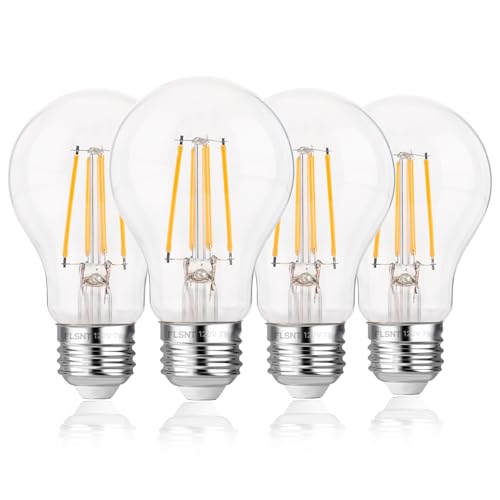
Clear glass enclosures allow these glowing LED filaments to showcase their distinctive decorative patterns inside exposed fixtures. Vintage teardrop ST58 bulbs, such as the Ascher Vintage LED Edison Bulbs, 6W, use classic squirrel-cage filament arrangements to create historic ambiance. Standard spherical A19 bulbs, including the FLSNT 60W Equivalent Dimmable A19 LED Light Bulbs, provide a familiar rounded profile for traditional shaded fixtures. These clear designs preserve the aesthetic warmth of nineteenth-century engineering while reducing heat output inside residential living spaces.
Energy conservation marks the most significant practical distinction between historical incandescent lamps and modern LED filament bulbs. A traditional carbon or tungsten bulb consumes 60 watts of electric power to produce standard residential illumination. By comparison, modern LED filament bulbs like the Sylvania A19 Clear LED White Filament Bulb, 6.5W draw only 6.5 watts while generating comparable illumination. This dramatic reduction in power consumption protects home electrical circuits from high thermal loads and lowers monthly utility expenses.
Operational lifespan has also expanded dramatically compared to historic lighting options. Thomas Edison’s early commercial bulbs operated for roughly 1,200 hours before filament failure occurred. Modern LED filament options like the ASOMST 4-Pack Vintage Edison LED Bulbs carry rated lifespans of up to 25,000 hours based on manufacturer specifications. That longevity minimizes the need for frequent bulb replacements in hard-to-reach ceiling fixtures, pendant lights, and high chandeliers.
Color Temperature, Brightness, and Color Rendering in Filament Lighting
Color temperature plays a defining role in how filament bulbs illuminate architectural surfaces and interior furnishings. Most vintage-style LED filament bulbs utilize a 2700K soft white color temperature that matches the amber warmth of antique carbon filaments. This soft color quality creates an inviting, relaxing atmosphere that works exceptionally well in dining rooms, living spaces, and bedrooms. In open dining spaces featuring exposed fixtures, pairing warm filament bulbs with careful maintenance, such as caring for brass chandeliers, helps preserve an authentic historic aesthetic.
Certain modern tasks require crisper illumination than traditional amber bulbs can provide. Options like the ASOMST vintage bulbs offer a daylight white 5000K color temperature producing 850 lumens of bright light. A cooler color temperature provides high contrast and energetic clarity for utility spaces, home offices, and kitchen prep islands. Choosing between 2700K and 5000K depends entirely on whether your fixture serves as decorative ambient accent lighting or functional task illumination.
Color rendering index, commonly designated as CRI, measures how faithfully artificial illumination reveals the true colors of objects compared to natural daylight. Both the FLSNT and Ascher filament bulbs feature CRI ratings of 80 or higher, while ASOMST lists an 85+ CRI rating. Higher CRI ratings ensure that wooden tables, painted walls, fabrics, and food retain rich, vibrant hues under artificial light. When selecting filament bulbs for living spaces, checking the listed CRI rating prevents rooms from looking washed out or gray.
Fixture Sockets, Dimming Controls, and Operating Conditions
Mechanical fit represents the initial compatibility checkpoint when choosing filament bulbs for existing fixtures. Most residential filament bulbs feature a standard E26 medium screw base, which fits typical ceiling pendants, wall sconces, and table lamps. Homeowners should verify fixture depth and shade clearance before purchasing elongated bulb shapes like the ST58 teardrop style. Proper placement around beds and desks also matters, matching the careful planning needed when positioning bedside reading lights for comfortable glare-free reading.
Dimming compatibility requires careful verification because not all LED filament bulbs support variable light output. The FLSNT A19 and Sylvania clear filament models are explicitly listed as dimmable, allowing users to modulate light levels between low ambient glow and full brightness. Conversely, the Ascher ST58 and ASOMST ST58 models are strictly non-dimmable. Installing non-dimmable bulbs on a dimmer switch can cause annoying buzzing sounds, rapid flickering, and premature driver failure.
Operating environments and fixture enclosures also influence which filament bulb safely suits your installation. Sylvania notes that its clear filament bulb is approved for use in enclosed fixtures and wet locations, making it suitable for protected outdoor lanterns or damp bath areas. Many decorative LED filament bulbs contain compact internal drivers that require adequate ventilation to dissipate heat properly. Always check manufacturer specifications regarding enclosed fixture suitability before sealing a clear filament bulb inside a tight glass globe.
Electrical safety requires turning off the wall switch or main circuit breaker before inserting or removing any glass bulb. Allow older incandescent bulbs to cool completely before touching the glass envelope, as traditional filaments generate intense surface heat. Inspect the brass socket contacts inside the fixture for signs of corrosion, wear, or physical deformation before screwing in a replacement. Following the fixture manufacturer’s maximum wattage ratings ensures safe, reliable operation throughout the life of the bulb.
Selecting the Best Filament Aesthetic for Everyday Living
Selecting the right filament bulb comes down to balancing historical nostalgia with modern lighting performance. Clear glass bulbs excel in open wire cages, clear glass pendants, and exposed chandelier sockets where visible filaments become an artistic focal point. For fixtures with frosted or translucent shades, standard diffuse bulbs may be preferable since the decorative filament remains hidden from view. Evaluating whether your space benefits from amber warmth or crisp daylight white ensures your lighting matches the room’s primary daily activities.
The transition from nineteenth-century carbon experiments to modern micro-LED filaments reflects more than a century of electrical refinement. Inventors like Swan, Edison, Latimer, and Coolidge solved monumental engineering challenges so people could enjoy reliable indoor lighting. Today’s consumer LED filament bulbs honor that historical craft while providing clean efficiency, extended lifespans, and versatile dimming controls. Checking base dimensions, lumen output, and control compatibility will help you choose the ideal filament bulb for any residential fixture.




Write Your Review
No reviews yet. Be the first to share your experience!