


Clear glass bulbs often reveal a glowing thread or strip suspended inside the glass envelope. Many homeowners looking at exposed vintage fixtures or replacing burned-out lamps ask what is the filament of a light bulb and how it generates usable illumination. In traditional incandescent lighting, this component is a thin wire heated to high temperatures by an electric current. Modern lighting maintains this beloved exposed aesthetic through micro-LED strips designed to resemble vintage carbon or tungsten coils while using significantly less electrical energy.
Understanding this central component makes it much easier to select appropriate replacements for open pendants, chandeliers, and decorative sconces. Readers curious about the physics behind these glowing threads can explore our detailed article on how bulb filaments work across different generations of lighting design. Matching your socket requirements, desired brightness in lumens, and color temperature ensures that your fixture looks balanced without producing harsh glare. Considering dimming controls and fixture ventilation beforehand prevents premature failures and keeps your living spaces warmly illuminated.

Pros
- Exposed filament and clear amber glass provide an authentic vintage aesthetic without high incandescent energy draw.
- Low 4-watt electrical consumption significantly reduces power usage compared to traditional 60-watt bulbs.
- Smooth 10% to 100% dimming capability works with most standard LED dimmers for customized room ambiance.
- Instant full-brightness activation delivers 300 lumens without any warm-up period.
- Standard E26 base offers wide compatibility across common residential and commercial light fixtures.
Cons
- Listed 300-lumen output is intended for soft accent and decorative illumination rather than heavy task lighting.
- Amber-tinted glass creates a warm decorative cast that may not suit spaces needing clean, neutral white light.
- Pack includes a single bulb, requiring multiple purchases to fill multi-socket chandeliers or sconce sets.
The Feit Electric A19 Vintage Exposed Filament LED Light Bulb is designed for homeowners, apartment dwellers, and commercial spaces seeking classic antique styling combined with modern electrical efficiency. Featuring exposed LED filaments wrapped in a clear amber glass housing, this bulb reproduces the nostalgic look of early incandescent lighting. It fits standard household fixtures and appeals particularly to decor-conscious shoppers looking to enhance exposed-bulb chandeliers, wall sconces, or accent lamps.
Regarding illumination performance, the bulb delivers 300 lumens of soft white light with a warm ambient character. Because it is rated at 300 lumens, this bulb is engineered primarily for mood, accent, and decorative illumination rather than intense task lighting or wide-area workshop utility. The light activates immediately upon flipping the switch with zero warm-up lag, maintaining stable color output. Its dimming capability ranges smoothly from 10% to 100% on most standard LED dimmers, enabling users to adjust evening ambience to their personal preference.
Build specifications highlight an authentic A19 shape measuring 4.2 inches long and 2.4 inches in diameter, weighing just 0.1 pounds. The transparent amber glass enclosure showcases the internal filament structure, enhancing decorative fixtures where the bulb remains in plain view. Equipped with a standard E26 medium screw base, the bulb seats securely into standard U.S. residential lamp sockets, entry sconces, and showcase fixtures without requiring special wiring or adapters.
Installation is straightforward and requires only threading the bulb into any compatible, unpowered E26 socket. Routine ownership is equally hassle-free, needing only occasional exterior wiping with a soft, dry cloth. When paired with an LED-compatible wall dimmer, users can easily dial light levels down to 10% for relaxed evening meals or raise it to full output for casual room lighting.
Buyers should keep in mind that the 300-lumen output produces gentle ambient light rather than bright overhead illumination for reading or detailed kitchen prep. In addition, dimming performance depends on using dimmers designed for LED loads, as older incandescent-only wall switches may not support the full 10% to 100% dimming sweep. The amber-tinted housing also imparts a distinctly warm cast that may not suit spaces requiring neutral or cool daylight balance.
For anyone looking to enhance living rooms, dining fixtures, display cases, or hospitality areas with timeless exposed-filament appeal, the Feit Electric A19 LED bulb provides a dependable and energy-efficient solution. Replacing a 60-watt traditional incandescent with just 4 watts of power consumption, it offers classic visual warmth with modern electrical savings.
This Feit Electric vintage bulb supports smooth dimming from 10% to 100% brightness, making it easy to create relaxed evening atmospheres or brighter ambient levels.
To achieve the stated dimming range, ensure the bulb is installed on a circuit with a modern dimmer switch compatible with LED loads, as legacy controls may cause performance discrepancies.
Consuming only 4 watts of electrical power, this LED bulb serves as an energy-efficient alternative to traditional 60-watt incandescent bulbs.
According to manufacturer specifications, shifting from an incandescent equivalent to this 4-watt LED provides up to 93.3% energy savings, helping households reduce everyday lighting power consumption without losing vintage aesthetic charm.

Pros
- Significant energy reduction drawing 4.5 watts while replacing 60-watt incandescents
- UL-Listed safety certification with a damp-location rating for added fixture versatility
- Instant full brightness at 450 lumens without warm-up lag
- Classic clear filament design suits exposed-bulb fixtures like chandeliers and sconces
- Long manufacturer-rated lifespan of up to 25,000 hours based on 3 hours of daily use
Cons
- Small E12 screw base is incompatible with standard household E26 medium sockets without an adapter
- Fixed 2700K soft white output does not allow for tunable white or color adjustments
- Dimming performance is contingent upon using a compatible modern dimmer switch
The FLSNT 60W Equivalent B11 LED Candelabra Bulb pack provides an energy-conscious lighting solution designed specifically for decorative fixtures. Operating on a compact E12 screw base, these bulbs are well suited for dining room chandeliers, living room wall sconces, foyer lanterns, and decorative ceiling fans. Homeowners and renters seeking to replace high-draw incandescent bulbs without sacrificing the vintage aesthetic of exposed filaments will find this six-pack practical for multi-socket installations.
Regarding illumination performance, each bulb outputs 450 lumens at a 2700K soft white color temperature, creating a warm and welcoming ambiance throughout living spaces. The 4.5-watt power consumption offers an efficient alternative to traditional 60-watt incandescent bulbs. Light delivery is instantaneous, achieving full brightness immediately upon flicking the switch without the noticeable warm-up period seen in older energy-saving formats. The integrated dimming support allows users to modulate the light level to suit dinner parties, quiet evenings, or general ambient lighting needs.
In terms of build and form factor, the bulbs feature a clear B11 torpedo profile measuring roughly 1.38 inches in diameter and 3.82 inches in overall length. The internal vertical LED filament design preserves the look of historic carbon-filament lamps while maintaining modern solid-state reliability. For safety and compliance, the bulbs are UL-Listed to protect against electrical shock and fire hazards, and they are mercury-free. Their damp-location rating ensures they can be safely deployed in humid indoor environments like master bathrooms as well as covered exterior areas like screened porches.
Installation requires no special tools beyond carefully screwing the E12 base into any compatible candelabra socket. Because multi-bulb chandeliers often use five to eight sockets simultaneously, swapping out a cluster of 60-watt incandescent bulbs for these 4.5-watt units provides an immediate drop in overall fixture wattage. Daily operation is straightforward, though buyers intending to use dimming functionality must ensure their wall switch is compatible with modern LED loads to avoid unwanted performance issues.
A few practical limitations should be noted prior to purchase. These bulbs utilize a small E12 candelabra base, which will not thread into standard E26 medium sockets commonly found in standard table lamps or flush-mount fixtures without an adapter. Additionally, the color temperature is locked at 2700K, meaning those who prefer neutral or daylight tones for focused task lighting will need a different Kelvin rating. While dimming is supported across most newer dimmers, older legacy incandescent dimmers may experience irregular behavior or limited dimming range.
Overall, the FLSNT 60W Equivalent LED Candelabra Bulbs offer a dependable, attractive upgrade for standard decorative fixtures. With a solid 450-lumen output, classic filament styling, UL-Listed safety credentials, and damp-location flexibility, this six-pack represents a sensible investment for anyone refreshing their home's chandelier or sconce lighting.
These FLSNT candelabra bulbs are built with a standard E12 miniature screw base, measuring 12 millimeters in diameter. This smaller socket format is widely used across American decorative fixtures, including dining chandeliers, bathroom vanity sconces, entryway pendants, and ceiling fan light kits.
Before installing, verify that your fixture uses the smaller E12 socket rather than a standard E26 medium base. These bulbs thread directly into 120V E12 fixtures with standard clockwise rotation, providing a secure mechanical and electrical fit without requiring specialized adapters.
The FLSNT B11 LED bulbs feature dimmable internal circuitry designed to adjust light output smoothly across compatible controls. Dimming the filament reduces brightness from the maximum 450 lumens down to lower ambient levels suitable for mood or evening lighting.
To achieve reliable dimming results, pair these bulbs with modern LED-rated dimmer switches. Older rheostat or high-wattage incandescent dimmers may not detect the low 4.5-watt load properly, which can lead to reduced dimming range or buzzing.
Each bulb in this pack draws only 4.5 watts of electrical power while producing 450 lumens, providing equivalent light levels to a standard 60-watt incandescent candelabra bulb. In a typical five-light chandelier, total power consumption drops from 300 watts down to roughly 22.5 watts.
The manufacturer lists an estimated operational life of 25,000 hours based on an average use of 3 hours per day. This longevity significantly reduces the frequency of ladder climbing to replace burned-out bulbs in high-ceiling fixtures.


Pros
- Classic ST58 antique styling combines decorative filament aesthetics with modern energy savings.
- Generates 800 lumens per bulb, offering ample light output for chandeliers, dining tables, and accent lamps.
- Dimmable from 10% down to 100% without buzzing or noticeable flicker when paired with compatible dimmers.
- Standard E26 base makes installation quick and simple in standard household light fixtures.
Cons
- Exposed clear glass design can produce direct filament glare if installed in unshaded fixtures at eye level.
- Fixed 2700K warm white profile does not offer adjustable color temperature or cool daylight tones.
- Dimming performance relies on dimmer switch compatibility to achieve the full low-end 10% range.
The DAYBETTER ST58 Vintage LED Edison Bulb set is a four-pack of decorative filament lamps engineered for standard household sockets. Designed to match the look of historic carbon-filament lamps while using modern solid-state electronics, these bulbs target homeowners, renters, and decor-focused buyers seeking to update exposed-bulb fixtures without sacrificing warm atmosphere. They provide a practical aesthetic upgrade for chandeliers, kitchen island pendants, wall lanterns, and bedside lamps.
In terms of lighting output, each bulb generates 800 lumens on full brightness, providing illumination comparable to a standard 60-watt incandescent bulb while drawing significantly less power. The 2700K warm white color temperature produces an amber, relaxing glow that suits residential living rooms, dining spaces, and bedrooms. With a listed Color Rendering Index (CRI) of 80+, interior colors, wood finishes, and decor remain naturally rendered without artificial dullness.
The build centers on high-strength clear glass molded into a traditional ST58 teardrop envelope. Inside, four vertical LED filaments deliver broad, omnidirectional light transmission without the bulk of modern plastic heat sinks. The bulbs run significantly cooler than traditional incandescent options and contain no mercury, UV, or infrared emissions. At the base, standard E26 metal threading ensures broad compatibility across standard North American lighting fixtures.
Installation requires nothing more than screwing the bulb into a compatible medium E26 socket. The internal driver supports smooth dimming from 100% down to 10% on most standard dimmers, allowing users to move from task-level brightness down to an intimate evening ambiance. The manufacturer notes flicker-free and quiet operation, preventing the distracting hums that sometimes plague lower-tier decorative LED retrofits.
A natural limitation of clear ST58 bulbs is visual intensity when looking directly at the bare filament at maximum brightness. For fixtures positioned directly at eye level, such as bathroom vanities or low-hanging dining lights, users may prefer keeping them dimmed or pairing them with lightly frosted shades. Additionally, the fixed 2700K color profile cannot be adjusted to neutral or cool daylight, making it purely an ambient and warm-accent choice.
For buyers who want classic vintage character, dependable 800-lumen output, and modern dimming flexibility, this four-pack offers exceptional everyday utility. Supported by an over 15,000-hour rated lifespan and a 12-month service window, the DAYBETTER ST58 pack provides a straightforward, cost-effective upgrade for any exposed-bulb fixture in the home.
Each DAYBETTER ST58 bulb produces 800 lumens at full power, which is the standard output expected from a traditional 60-watt incandescent light bulb. This level of illumination makes the pack bright enough for primary multi-bulb fixtures, such as kitchen island pendants and dining chandeliers, while maintaining comfortable residential warmth.
Because the bulbs utilize transparent clear glass rather than frosted diffusion, light distribution is broad and immediate. When installed in multi-socket fixtures, four bulbs combine to provide substantial ambient illumination suitable for general room lighting.
These bulbs feature an integrated dimmable LED driver engineered for smooth output adjustments between 10% and 100%. This range provides practical flexibility, letting you switch from bright meal preparation light down to low-level mood lighting with a simple slider adjustment.
The manufacturer highlights quiet, hum-free operation and consistent output without visible flicker across compatible household dimmers. To ensure the full 10% low-end dimming threshold is achieved, verify that your wall switch supports dimmable LED loads.
Equipped with a standard E26 medium screw base, these bulbs screw directly into standard American residential sockets. The ST58 form factor measures approximately 4.92 inches in length, retaining the vintage teardrop silhouette popularized by original antique incandescent lamps.
They are well-suited for exposed-socket applications including industrial pipe lamps, modern farmhouse chandeliers, open glass pendants, wall sconces, and desk fixtures where the internal filament aesthetic enhances the overall fixture design.

Pros
- Warm 2100K amber glow creates a cozy, relaxing ambiance in living rooms and dining areas
- Dimmable driver provides adaptable brightness levels to suit different times of day
- Standard E26 medium base ensures wide compatibility with standard household light fixtures
- Rated 15,000-hour operational life and 2-year warranty offer dependable long-term use
- Convenient 8-pack provides enough matching bulbs for multi-socket chandeliers or grouped fixtures
Cons
- 400-lumen rating is designed for mood and accent lighting rather than bright task illumination
- Fixed 2100K amber color temperature may be too warm for kitchens, home offices, or workspaces
- Product specifications do not list specific dimmer model compatibility or enclosed-fixture suitability
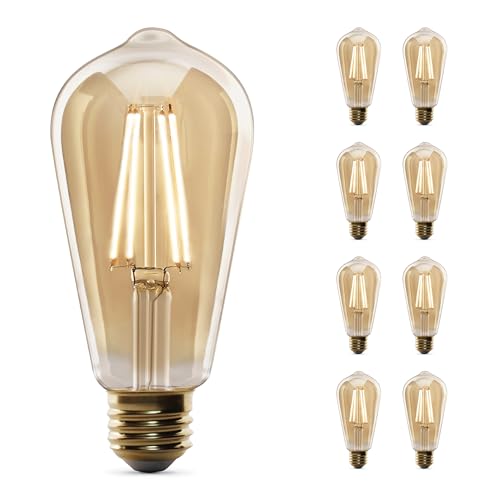
The Feit Electric ST19 Vintage Exposed Straight Filament LED Bulb is a decorative accent bulb designed for living spaces where aesthetic presentation matters just as much as illumination. Featuring clear amber glass and a vertical straight filament, this bulb replicates the look of historic carbon-filament lighting while using contemporary LED efficiency. Sold in a convenient eight-pack, it serves homeowners, renters, and hospitality-minded users who want a coordinated, warm look across multiple light fixtures.
In terms of light output, each bulb delivers 400 lumens of ultra-warm 2100K light, functioning as a 60-watt incandescent equivalent. The 2100K rating places the light on the deeply warm, amber end of the spectrum, producing a gentle, candle-like hue rather than a crisp white beam. This makes it especially suited for exposed-bulb fixtures, dining room chandeliers, living room wall sconces, and hanging entryway pendants where high-intensity task light would cause uncomfortable glare.
Physically, the bulb features the classic teardrop ST19 shape measuring 2.5 inches in diameter by 5.3 inches in height. It connects using an industry-standard E26 medium screw base, allowing direct installation into compatible residential and commercial sockets without requiring adapters. Feit Electric rates the internal LED components for up to 15,000 hours of operation, significantly reducing the maintenance cycle compared to vintage-style incandescent alternatives.
Everyday operation is enhanced by built-in dimming capability, giving users the flexibility to adjust the light output from soft background glow to full 400-lumen brightness. Installation is as simple as threading the E26 base into an unpowered fixture. Because the amber glass is transparent, keeping the exterior glass dust-free with a soft microfiber cloth ensures the exposed straight filament remains crisp and visually appealing when unlit.
Buyers should keep practical lighting limits in mind before purchasing. At 400 lumens per bulb, these units are tailored for ambient, mood, and accent lighting rather than detailed kitchen prep or home-office task work. In addition, the manufacturer specifications do not state enclosed-fixture ratings or an environmental wet-location designation, so standard dry indoor fixtures or protected setups are the safest application.
For those looking to achieve an authentic vintage cafe or bistro aesthetic throughout their home, this Feit Electric ST19 eight-pack is an appealing and reliable choice. It balances classic decorative charm with dimmable control, an E26 base, and energy-conscious performance backed by a 2-year warranty.
The Feit Electric ST19 bulb produces 400 lumens of light at a 2100K warm white color temperature. At 2100K, the light skews distinctly toward warm amber tones, effectively emulating the soothing glow of early incandescent carbon filaments.
This combination of 400 lumens and 2100K makes the bulb ideal for accent and relaxation lighting. It delivers sufficient illumination to highlight architectural details or set an inviting mood in open-cage fixtures without overwhelming the room with harsh brightness.
Each bulb is built with an E26 medium screw base, the standard socket size found across most residential fixtures in the United States. It screws directly into compatible pendants, wall sconces, ceiling fixtures, and decorative accent lamps.
The physical bulb profile follows the ST19 standard, measuring 2.5 inches wide and 5.3 inches tall. When choosing fixtures, ensure that glass shades or open metal cages provide sufficient clearance for the 5.3-inch length.
Feit Electric provides a 2-year warranty with these ST19 vintage LED bulbs, supporting dependable household operation. The bulbs are engineered with a 15,000-hour rated lifetime to provide long-term service under normal use.
With over 45 years in the lighting manufacturing industry, the brand offers established product support should any manufacturing defects or operational issues arise during the covered warranty period.

Understanding Light Bulb Filaments: Technology, Function, and Design
At its core, a light bulb filament is the conductive interior element that transforms electrical energy into visible light. In traditional incandescent lamps, this component consists of an ultra-fine coil of tungsten wire that glows when electrical resistance produces intense heat. Modern lighting has transformed this concept by replacing heated resistance wires with decorative LED strips called micro-LED filaments. These newer components recreate the warm visual charm of historic Edison bulbs while operating at a fraction of the operating temperature and power consumption.
The Fundamental Definition: What Does a Bulb Filament Do?
The primary function of any filament is to serve as the radiant light source within a bulb envelope. In conventional lighting, electric current flows through the base contacts into support wires that hold the filament securely in place. Because the filament material possesses high electrical resistance relative to its tiny cross-section, current cannot pass through easily. This restriction forces the material to absorb electrical energy and release it as radiant electromagnetic energy, which human eyes perceive as glowing light.
Historically, inventors tested hundreds of materials before adopting tungsten as the universal standard for incandescent filaments. Carbonized bamboo, platinum, and various carbon threads worked with limited lifespans before researchers discovered that tungsten possessed an exceptionally high melting point above 3,400 degrees Celsius. Even with tungsten, traditional filaments slowly evaporate over time inside their sealed glass enclosures. This microscopic evaporation eventually causes the thin wire to thin out unevenly, snap under thermal stress, and permanently open the electrical circuit.
Traditional Incandescent Filaments Versus Modern LED Filaments
The lighting industry has largely shifted away from thermal incandescent wires in favor of advanced LED filament designs. Rather than heating a continuous metallic strand to white-hot temperatures, LED filaments use an array of microscopic light-emitting diodes mounted along a thin substrate. This arrangement is commonly referred to in technical manufacturing as Chip-on-Glass or Chip-on-Sapphire construction. The diodes emit an energetic blue light that passes through a surrounding silicone or resin coating filled with yellow phosphors, yielding a warm and uniform glow.
This fundamental difference in operating physics completely alters how energy is consumed within the fixture. Traditional incandescent filaments convert roughly ten percent of their electrical input into visible illumination, while releasing the remaining ninety percent as infrared heat. LED filament bulbs reverse this efficiency curve by converting a substantially larger proportion of energy directly into light without scorching the bulb glass. Because the diodes generate minimal infrared radiation, modern filament bulbs operate much cooler and place significantly lower stress on surrounding socket fixtures.
Durability also distinguishes modern LED filaments from their delicate incandescent ancestors. A standard tungsten filament is notoriously fragile, often fracturing if a lamp is bumped, subjected to mechanical vibration, or exposed to cold drafts while illuminated. In contrast, solid-state LED filaments lack loose vibrating coils that can shatter from sudden physical movement. This structural resilience allows homeowners to use decorative filament bulbs in floor lamps, ceiling fans, and high-traffic entryways where traditional incandescent bulbs would frequently break down.
Filament Shapes, Arrangements, and Aesthetic Impact
Exposed-filament lighting has grown exceptionally popular because the internal elements contribute directly to the architectural character of a room. Clear glass enclosures allow the distinctive internal geometry of the filament to remain fully visible whether the fixture is turned on or off. Manufacturers configure LED filaments in several distinct layouts, including straight vertical pillars, crisscrossed squirrel-cage columns, and flexible spiral ribbons. Straight filaments offer a clean, balanced presentation that suits both historic fixtures and sleek industrial designs.
Bulb glass envelopes are deliberately shaped to complement the internal filament style and optimize overall light distribution. Classic pear-shaped A19 bulbs distribute light broadly across general living areas, whereas elongated ST58 and ST19 teardrop profiles emphasize nostalgic early twentieth-century aesthetics. For smaller multi-arm fixtures, slender B11 torpedo or candle-shaped envelopes house compact vertical filaments that fit inside tight decorative shades. Matching the filament layout to the specific fixture profile ensures that the lamp serves as a visual centerpiece rather than an afterthought.
Brands like Feit Electric and Ascher emphasize these decorative qualities by pairing exposed straight filaments with specialized amber-tinted or crystal-clear glass housings. In exposed pendant drops and clear glass wall lanterns, a bulb with prominent vertical filaments creates an inviting focal point. When lights are suspended at eye level above a dining table or kitchen island, the visual pattern of the filament creates a refined ambiance. Selecting clear or lightly tinted glass helps the filament pattern stand out without obstructing the total beam spread.
Labeled Brightness and Color Temperature in Filament Lighting
Many consumers mistakenly evaluate a bulb’s brightness by checking its wattage rating on the packaging. Wattage measures only electrical power consumption, whereas lumens indicate the actual volume of light emitted by the filament. In modern lighting, a six-watt LED filament bulb can produce seven hundred to eight hundred and fifty lumens, matching the light output of an older sixty-watt incandescent lamp. Checking the lumen rating directly prevents you from purchasing an underpowered bulb for task areas or an overly bright option for relaxing spaces.
Color temperature is measured in kelvins and defines the visual warmth or coolness of the light emitted by the filament. Lower kelvin ratings produce warmer, amber-tinted light, whereas higher ratings emit crisp, neutral, or cool white light. Filament bulbs designed for cozy accent lighting, such as those emitting 2100K or 2700K, mimic the soothing hue of early evening firelight or antique incandescent lamps. You can review our practical guide on bulbs designed for warm cozy lighting to see how warmer kelvin levels influence interior mood.
Not all decorative filament bulbs produce an antique golden hue, as contemporary spaces sometimes require crisp visibility. Products from brands like MAXvolador and ASOMST utilize phosphor-coated LED filaments calibrated to 5000K daylight white. These higher kelvin ratings deliver clean, energizing illumination that works well in modern bathrooms, walk-in closets, and craft rooms. Selecting the correct color temperature depends entirely on the functional purpose of the room and your personal comfort preference.
Dimming Compatibility and Control Requirements
Controlling the light output of an exposed-filament bulb is one of the most effective ways to customize room ambiance. However, dimming performance depends entirely on the internal circuitry built into the bulb base. Dimmable filament bulbs contain specialized driver components designed to interpret changes in electrical voltage or phase cutting without producing noticeable flicker. If a bulb packaging explicitly indicates dimmable performance, it can typically dial smoothly between full brightness and low ambient levels when paired with a compatible switch.
Non-dimmable filament bulbs, such as select units produced by Ascher, lack this specialized regulating circuitry. Connecting a non-dimmable LED bulb to a dimmer switch can result in rapid flickering, audible humming, and severe driver overheating. Over time, the internal driver components inside non-dimmable bulbs degrade rapidly when starved of constant alternating current. Homeowners should always verify that the product carton or documentation specifies dimmable capability before attempting to use bulbs on existing dimmer circuits.
Dimmer switch technology also plays an essential role in whether your filament bulbs operate silently and reliably. Older incandescent dimmers often require a substantial minimum electrical load that highly efficient low-wattage LED filaments cannot meet. When electrical loads fall below the switch threshold, bulbs may buzz, drop off abruptly, or fail to extinguish completely when switched off. Installing modern electronic low-voltage or dedicated LED dimmer switches resolves these compatibility hurdles and provides a clean, continuous dimming range.
Operating Conditions, Heat Dissipation, and Enclosed Fixtures
Although LED filament bulbs generate dramatically less thermal energy than incandescent lamps, managing internal heat remains critical for long operating life. The tiny diodes along the filament transfer heat into the surrounding carrier substrate and the internal gas mixture within the glass envelope. Many manufacturers fill the sealed glass globe with thermally conductive inert gases, such as helium, to carry heat away from the diodes toward the outer glass surface. This passive cooling mechanism maintains stable junction temperatures without requiring bulky aluminum heat sinks around the base.
Operating a decorative bulb inside a fully enclosed or unventilated fixture can trap rising heat and strain delicate driver electronics. Prolonged exposure to excessive ambient heat accelerates lumen depreciation and can cause internal solder joints to fail prematurely. For deeper insight into how thermal energy impacts different lighting types, consult our informative article discussing heat generation in lighting fixtures. Choosing bulbs explicitly rated by the manufacturer for enclosed fixtures or damp locations, such as designated models from Sylvania, helps protect your investment.
Outdoor lighting fixtures also demand close attention to environmental protection ratings. Damp-rated filament bulbs can safely handle humidity and moisture vapor in covered porches, patios, and bathroom vanity areas. However, fixtures directly exposed to blowing rain or pooling water require wet-rated bulbs and sealed weatherproof housings. Verifying these manufacturer ratings ensures that water intrusion does not cause electrical shorting across the socket or corrode the metallic base contacts.
Base Types and Physical Clearance in Decorative Fixtures
A decorative filament bulb can only perform properly if its base matches the fixture socket exactly. The standard North American household base is the E26 medium screw base, which measures twenty-six millimeters across its threaded barrel. Smaller accent fixtures, chandeliers, and decorative wall sconces frequently employ the E12 candelabra base, measuring twelve millimeters in diameter. Attempting to force an incorrect base into a socket can strip the metal threads or create a dangerous, intermittent electrical connection.
Physical clearance inside the fixture shade or glass enclosure is another crucial consideration during bulb selection. While standard A19 bulbs share a familiar compact profile, vintage-style ST58 or ST19 bulbs feature extended tubular necks and teardrop glass bodies. These extended dimensions can cause the tip of the bulb to press against glass lanterns or protrude awkwardly past wire cage frames. Checking both the overall length and maximum diameter listed on the product specifications ensures an uncluttered fit inside your chosen fixture.
Safe Handling, Care, and Basic Bulb Troubleshooting
Handling glass filament bulbs requires basic safety awareness to prevent accidental breakage or socket damage. Always switch off power at the wall control or circuit panel and allow existing bulbs to cool before touching them. Grasp the bulb firmly around the main glass body or base collar rather than twisting forcefully on the glass tip. If a bulb becomes difficult to unthread, gentle backward and forward pressure can break any corrosion holding the metal threads to the socket contact.
When an installed filament bulb fails to turn on or begins to flicker, safe bulb-level troubleshooting can help pinpoint the issue. First, confirm that the bulb is threaded fully into the socket so the center brass tab makes solid contact. If the issue persists, swapping the bulb into another known working fixture will quickly reveal whether the fault lies in the bulb driver or the fixture wiring. Disposing of failed LED filament bulbs is straightforward because they contain no hazardous mercury, though following regional electronic recycling guidelines remains good practice.
Selecting the Right Filament Bulb for Your Living Space
Choosing an ideal filament bulb comes down to balancing visual presentation with functional room requirements. For dining rooms and intimate seating areas, warm amber bulbs rated between 2100K and 2700K offer flattering, relaxing illumination that highlights architectural details. In work areas, kitchens, or bathrooms, higher-lumen filament bulbs emitting neutral or daylight tones provide the visual clarity needed for everyday tasks. Ensuring that your chosen bulbs match your dimmer configurations and socket sizes guarantees consistent lighting across your entire home.
Modern exposed-filament bulbs successfully unite historic design traditions with current energy-saving engineering. Whether you are replacing a single burned-out lamp or outfitting an entire chandelier, checking the base type, lumen rating, and dimming compatibility will ensure dependable performance. Paying attention to manufacturer specifications helps you avoid mismatched colors, inadequate brightness, and early driver failures. By matching your lighting choices to each specific living area, you can enjoy timeless aesthetic warmth with dependable everyday reliability.






Write Your Review
No reviews yet. Be the first to share your experience!