


Fumbling through a darkened drawer for a power cable often reveals an unexpected hurdle when recharging modern tactical torches. Many compact handheld units do not place a direct charging port on the outer barrel, prompting users to investigate the proper kub flashlight charger location before their next outdoor trip or emergency situation. In tactical designs like the PeakPlus Rechargeable Tactical Flashlight LFX1000, power delivery relies on a dedicated standalone USB cradle rather than an integrated port on the aluminum chassis. This configuration protects internal electronics against moisture penetration and dust ingress while keeping your tactical illumination gear ready for heavy use. Pairing a dependable torch with supplemental emergency fixtures or protective padded illumination setups ensures continuous visibility during sudden power cuts.
Understanding your charging hardware prevents unnecessary downtime when you need reliable lighting the most. Tactical systems that utilize external charging cradles allow you to inspect the rechargeable lithium cell, verify contact points, and swap in backup AAA cells using an adapter cage without waiting beside an outlet. Stated specifications highlight zoomable optics that throw a concentrated beam up to 600 feet, making precise battery management vital for distance visibility and wide-area flooding alike. Keeping track of the charging cradle alongside spare batteries guarantees that your high-output LED flashlight maintains optimal beam performance during nightly walks, roadside maintenance, or weekend camping excursions.
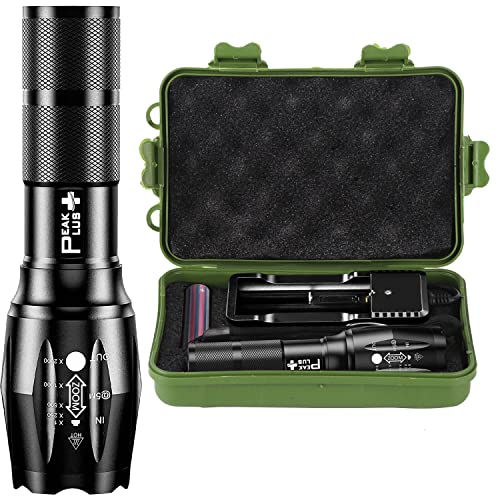
Pros
- Dual battery options ensure operation even during extended outages when charging outlets are unavailable.
- Versatile zoom lens adjusts easily between long-range spotting and close-up task lighting.
- Durable, water-resistant construction holds up against outdoor conditions, rain, and minor drops.
- Complete kit includes a hard case, charging dock, and multiple power adapters right in the box.
Cons
- Lacks an official numerical ANSI lumen specification or Kelvin color temperature rating in the manufacturer data.
- Battery must be removed and charged in an external USB dock rather than via an integrated on-body charging port.
- Listed as water resistant without a specific IPX rating, meaning it is not suitable for water submersion.
The PeakPlus LFX1000 is a handheld LED tactical flashlight package tailored for homeowners, outdoor campers, drivers, and emergency prep shoppers. Built in a compact handheld form factor measuring 5.3 by 1.6 by 1.1 inches, it is sized for easy storage in utility drawers, nightstands, and vehicle consoles. Because it operates on both an included rechargeable battery and standard AAA alkaline cells, it directly addresses the need for dependable illumination during severe weather, seasonal storms, and routine home repairs.
Regarding light output and beam performance, the flashlight uses a high-power LED emitter that the manufacturer rates as ten times brighter than legacy incandescent bulbs. An adjustable telescoping head allows users to manipulate the beam focus from a tight spotlight to a wide floodlight. In spotlight mode, the lens concentrates light into an intense beam throwing up to 600 feet ahead, while the floodlight mode distributes illumination broadly across walkways, campsites, or work benches. Five functional modes allow users to alternate between Full, Medium, Low, Strobe, and SOS output depending on situational demands.
Build quality centers on durability and outdoor resilience, featuring a skid-proof, anti-abrasive textured exterior designed for secure handling in slick conditions. The housing is specified as water resistant, providing sufficient defense against surface splashes, rain, and damp outdoor environments. The entire set comes packed in a protective hard carrying case and includes a dedicated USB charging dock, battery sleeve, AAA battery cage, and user manual, making it a self-contained portable lighting solution.
Everyday handling and battery management are straightforward, aided by the flashlight's modest 0.7-pound weight. You can keep the proprietary rechargeable cell topped off using standard USB wall adapters, laptops, or portable power banks via the included external charger. For extended power outages where electrical outlets are offline, swapping in three standard AAA batteries using the internal cage ensures immediate continuity without waiting on recharge cycles.
Buyers should keep a few realistic product limitations in mind before purchasing. The manufacturer does not list exact numerical lumen figures, CRI scores, or color temperature ratings, making precise photometric comparisons difficult. Additionally, recharging requires taking the battery out of the flashlight to place it in the standalone USB charging cradle, rather than plugging a cable directly into an integrated port. The water-resistant designation also warrants caution around heavy downpours or standing water, as it is not rated for full immersion.
For homeowners, vehicle owners, and outdoor hobbyists seeking an economical, multi-functional tactical flashlight kit, the PeakPlus LFX1000 offers balanced practical value. Its dual-fuel capability, adjustable zoom, multiple modes, and included accessory package make it an accessible safety tool for households and workshops alike. Backed by a one-year replacement warranty, it serves as a reliable emergency light source for routine and unexpected power outages.
The PeakPlus LFX1000 features a manual zoomable head that enables fast transitions between concentrated distance illumination and wide peripheral coverage. In spotlight configuration, the optics focus the LED beam to project up to 600 feet ahead, assisting with long-range property checks, dark trail navigation, and outdoor security sweeps.
Retracting the bezel opens the beam into a broad floodlight pattern. This wide-angle distribution illuminates immediate surroundings evenly, making it practical for changing flat tires, checking circuit breakers, lighting up a tent interior, or working under dark kitchen cabinets without creating an overexposed focal spot.
This tactical light is packaged as a comprehensive kit designed for immediate deployment. Inside the protective hard-shell storage case, you receive the LFX1000 LED flashlight, one rechargeable battery manufactured specifically for the unit, a clear battery sleeve, and a single-bay USB battery charging dock.
To provide dual-power redundancy, PeakPlus also includes an AAA battery holder. This accessory lets users power the flashlight with three off-the-shelf AAA alkaline batteries whenever the rechargeable cell is depleted, ensuring reliable performance during prolonged emergencies when grid charging is unavailable.
PeakPlus backs the LFX1000 flashlight with a one-year no-questions-asked replacement warranty. This coverage safeguards buyers against manufacturing defects, switch malfunctions, and charging equipment issues under normal operational conditions.
Customer support is available directly through the manufacturer, with an advertised inquiry response time of under 24 hours. This clear warranty and accessible customer service provide helpful post-purchase protection for everyday household and emergency lighting buyers.
Frequently Asked Questions
Where is the charger located on this style of tactical flashlight?
An external charging cradle is standard for this model instead of a built-in barrel port. You remove the rechargeable battery from the flashlight body and insert it into the included USB cradle. This setup prevents port wear and keeps dirt out of the tactical housing during outdoor excursions. The charging cradle connects to any standard USB power source, showing an indicator light while replenishing the cell.
Can the flashlight operate on standard disposable batteries?
Yes, dual-fuel capability allows this unit to run on standard AAA alkaline batteries. The included AAA battery holder drops directly into the battery compartment when your rechargeable cell runs flat. Having this secondary power option is essential for emergency kits where recharging access might be limited. Swapping between rechargeable power and alkaline cells takes only a few seconds in the dark.
How does the adjustable zoom mechanism affect the beam pattern?
Sliding the flashlight head alters the optical focus between an intense spotlight and an expansive floodlight. Stated specifications note that the focused spotlight mode projects a concentrated beam up to 600 feet ahead for distant observation. Pulling the head back widens the beam into a broad flood pattern that illuminates trails or campsites evenly without harsh glare. This versatile adjustment gives you both long-range visibility and immediate ground illumination from a single handheld light.
What do the different light modes provide during an emergency?
Five selectable lighting modes deliver tailored output levels for practical utility and distress signaling. The full brightness setting provides maximum illumination, while medium and low modes extend battery runtime for prolonged indoor power outages. Strobe mode produces a rapid flashing pattern designed for self-defense or drawing attention, and the dedicated SOS mode signals distress in morse code sequence. You cycle through these settings easily using the rear tactical tail switch.
Does an external battery charger offer advantages over built-in USB ports?
Yes, separate charging cradles enhance overall durability by eliminating vulnerable rubber port covers on the flashlight body. Integrated charging ports can accumulate moisture, sand, or pocket lint, leading to premature electrical failure. An external cradle also allows you to charge one battery while keeping the flashlight operational with a spare cell. This modular design helps maintain the water-resistant integrity of the aluminum casing over years of service.
How does secondary illumination complement a primary tactical torch in 2026?
Backup lighting ensures you have balanced coverage for hands-free and close-quarters tasks. While a tactical flashlight delivers intense directional throw, having compact illumination tools or soft ambient fixtures prevents eye strain during indoor activities. Relying on multiple light sources also mitigates the risk of sudden darkness if your primary device requires a recharge. A layered lighting approach remains the safest practice for home emergency preparedness in 2026.




Write Your Review
No reviews yet. Be the first to share your experience!