


Gathering family and hosting guests requires a balanced overhead lighting plan that keeps the central space inviting rather than harsh or dim. Homeowners frequently ask what type of ceiling light is best for living room setups because one fixture rarely handles every daily activity alone. Ambient illumination needs to fill open seating zones smoothly while preventing glare on television screens and reading areas. Layering ambient illumination alongside accent options like hanging decorative pendant lights can dramatically elevate how comfortable and flexible the area feels throughout the day.
Ceiling height, overall room dimensions, and fixture construction directly determine whether a compact flush mount, an open cage fixture, or an adaptable multi-bulb fitting makes the most sense. Low eight-foot ceilings generally benefit from streamlined close-to-ceiling profiles that keep sightlines clear, whereas taller rooms can accommodate textured fixtures with dimensional character. Careful attention to color temperature, total lumen output, and control compatibility ensures that your primary fixture supports relaxing evenings as effectively as daytime tasks. Evaluating how different fixture housings distribute illumination helps eliminate awkward shadows and creates a reliable foundation for your interior decor.

Matching Ceiling Fixture Types to Living Room Architecture and Daily Needs
Selecting the ideal overhead light requires understanding how ceiling clearance, room proportions, and daily living patterns interact. For standard eight-foot ceilings common in residential builds, a close-to-ceiling flush mount or semi-flush fixture provides reliable clearance while spreading illumination evenly across seating arrangements. Taller ceilings permit more dimensional profiles, including open-cage frames or suspended fixtures that double as architectural focal points. Ambient illumination should also work in harmony with your natural window exposure and secondary floor fixtures. The ultimate selection depends on whether your space prioritizes low-profile efficiency, interchangeable decorative bulbs, or specific color rendering for multifunctional living.
Flush Mount Fixtures for Standard and Low Ceilings
Flush mount ceiling lights attach directly against the ceiling plane, leaving no open gap between the fixture body and the drywall. This flat installation profile makes them the practical choice for living spaces with ceiling heights of eight feet or lower. In rooms where family members frequently walk beneath the central light, keeping clearance above seven feet maintains an open and comfortable atmosphere. Flush designs also avoid collecting dust on top surfaces, reducing routine cleaning requirements in active households. Low-profile fixtures preserve visual sightlines across open living areas without creating physical obstructions.
Modern flush mounts, such as the Airand LED Ceiling Light Fixtures Flush Mount, utilize low-profile housings that sit neatly out of direct sightlines. Compact square designs measuring approximately 12.8 inches wide distribute illumination across standard floor plans without dominating the ceiling visual. Sealed housings also keep insects and airborne debris out of the internal light cavity over years of continuous operation. When overhead space is strictly limited, these streamlined fixtures preserve head clearance while maintaining reliable broad-spectrum coverage. Their unobtrusive footprint fits cleanly into contemporary or minimalist living room aesthetics.
Semi-Flush and Open Geometric Fixtures for Visual Warmth
Semi-flush fixtures hang down a short distance from the ceiling canopy, creating a small vertical gap that allows light to reflect upward and outward. This gentle upward illumination highlights ceiling textures and creates a spacious visual sensation that flat ceiling fixtures cannot duplicate. Homes with nine-foot or ten-foot ceilings particularly benefit from this added dimensionality because it anchors the room without dangling into walking paths. The small air gap also simplifies airflow and thermal dispersion around high-output bulbs. This design bridges the gap between purely functional flush mounts and dramatic hanging pendants.
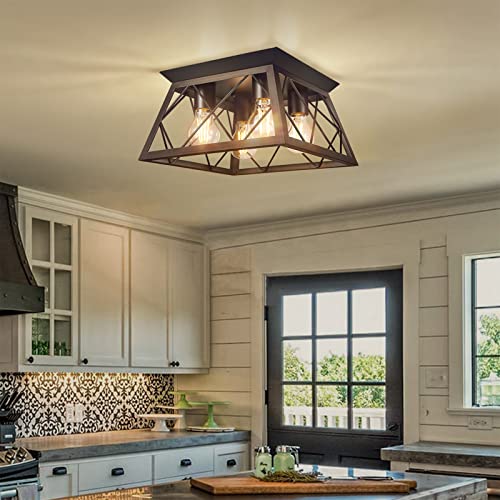
Open geometric cage designs deliver a compelling blend of industrial and farmhouse character for transitional living rooms. Fixtures like the FadimiKoo Flush Mount Ceiling Light Fixtures combine natural solid wood framing with dark metal accents to establish physical presence overhead. Because the cage lacks solid glass panels or heavy opaque diffusers, illumination radiates freely across 360 degrees into every corner of the room. This unrestricted optical distribution works especially well in open-concept floor plans where the living area connects directly into dining zones. Exposed architectural framing adds decorative interest to the ceiling even when the fixture is switched off during the day.
Evaluating Integrated LED Modules Versus Traditional Bulb Sockets
One of the most consequential decisions when choosing living room lighting involves deciding between integrated LED arrays and fixtures with traditional screw-in sockets. Integrated LED units build the light-emitting diodes directly onto an internal circuit board, eliminating conventional bulb sockets entirely. Fixtures like the Airand model house 240 specialized LED chips behind a dedicated milk-white cover, delivering uniform light without socket wobble or replacement hassles. Manufacturer specifications list this continuous array for a service life of up to 30,000 hours, equating to over a decade of normal daily operation based on eight hours of daily use. Eliminating individual bulbs creates a sleek profile that requires no maintenance during its active lifespan.
Traditional socket fixtures, by contrast, utilize standard medium-base sockets such as the E26 ceramic bases found in the FadimiKoo 4-light fixture. These ceramic sockets handle diverse bulb chemistries, including LED, CFL, halogen, or standard incandescent options up to 60 watts per socket. The primary advantage of screw-in sockets lies in personal customization and long-term modular maintenance. If you decide to transition from warm candlelight tones to crisper white light in the future, you simply change out the individual bulbs rather than replacing the entire ceiling fitting. This flexibility ensures your fixture can adapt whenever your interior design or personal lighting preferences change.
Lumen Requirements and Calculating Balanced Ambient Output
Calculating the appropriate brightness for a living room requires moving past obsolete wattage numbers and measuring actual luminous flux in lumens. General residential lighting recommendations typically call for 10 to 20 lumens per square foot of living area for everyday ambient illumination. A typical 200-square-foot living room therefore requires an overall ambient target between 2,000 and 4,000 lumens across all functional sources. Relying exclusively on a single central fixture to deliver all 4,000 lumens can create an uncomfortably intense spotlight effect in the middle of the room. A more effective strategy distributes total lumen needs between overhead fixtures, table lamps, and accent lighting.
A single high-efficiency integrated unit like the 24-watt Airand fixture produces approximately 2,050 lumens of luminous output. This output delivers substantial brightness while consuming a modest amount of electricity compared to traditional fluorescent tubes. Conversely, configuring a multi-socket fixture like the FadimiKoo unit with four 8-watt LED bulbs rated at 800 lumens each yields 3,200 lumens of distributed overhead light. Distributing lumens across four separate sockets or supplementing a central flush mount with secondary lamps ensures balanced ambient coverage without dark corners. Proper lumen planning prevents eye fatigue while keeping energy consumption predictable.
Color Temperature Dynamics Between Warm White and Daylight Tones
Color temperature, measured in kelvins, shapes the emotional atmosphere and functional utility of your primary living environment. Lower color temperatures around 2700K produce a soft, reddish-yellow glow reminiscent of incandescent bulbs and evening firelight. Warm white ranges between 2700K and 3000K encourage physical relaxation, making them the classic choice for family dens and TV viewing spaces. In contrast, higher color temperatures around 4000K to 5000K emit a crisp, bluish-white daylight tone that boosts alertness and enhances visual contrast. Selecting the right temperature ensures your overhead fixture matches the primary purpose of your living room.
The Airand ceiling fixture features a fixed 5000K daylight color profile that delivers intense clarity across the entire illuminated area. While 5000K provides exceptional visibility for task-heavy spaces or daytime reading, some homeowners find pure daylight tones overly cool for casual evening lounging. By contrast, multi-socket fixtures let you select E26 bulbs with exact color temperatures tailored to your wall colors and natural window exposure. North-facing rooms that receive cool outdoor light often feel cozier with 2700K bulbs, while multifunctional family spaces often thrive with neutral 3500K options. Having control over bulb temperature makes it easy to calibrate the visual warmth of your home.
Managing Glare, Beam Spread, and Light Diffusion
Visual comfort in living rooms depends heavily on how the fixture controls raw light output before it reaches human eyes. Direct unshielded light shining into the line of sight causes glare, which forces eye pupils to constrict and triggers eye strain over extended periods. Diffused fixtures solve this optical challenge by passing illumination through frosted glass, textured acrylic, or milk-white polymers. Diffusing panels break up concentrated point sources, spreading light rays across a wide surface area to generate soft, gentle ambient brightness. Good diffusion turns harsh glare into a comfortable wash of light.
The milk-white plastic housing on the Airand flush mount is engineered specifically to soften raw LED chip intensity and protect eyes from harsh glare. For open-frame fixtures that do not incorporate built-in diffusers, you can manage beam spread and contrast through secondary room fixtures. Consulting a practical reading lamp placement guide when setting up end-table light sources helps balance room luminance across multiple sightline elevations. Surrounding open ceiling cages with balanced perimeter lighting prevents uncomfortable high-contrast glare and flatters your architectural finishes. Proper beam distribution ensures every seating area receives flattering, consistent illumination.
Dimmer Compatibility and Dynamic Evening Control
Living rooms are inherently multifunctional spaces that demand different lighting levels for entertaining, reading, cleaning, and watching movies. Fixed-output ceiling lights that operate only at maximum brightness can feel overwhelmingly intense during late-night relaxation. Installing a compatible dimmer switch transforms a standard fixture into an adaptable lighting system that shifts output on command. Lowering overhead illumination in the evening creates an intimate environment while slightly reducing ongoing energy consumption. Flexible dimming control makes a single overhead fixture practical for both energetic gatherings and quiet movie nights.
Checking dimming compatibility before purchasing a ceiling fixture prevents disappointing flickering and electrical buzzing down the road. The FadimiKoo fixture utilizes standard ceramic sockets that pair seamlessly with external dimmer switches when equipped with dimmable E26 bulbs. Buyers must ensure that both the installed LED bulbs and the wall switch share compatible dimming technologies, such as trailing-edge electronic controls. Many integrated LED flush mounts feature non-dimmable internal driver circuits designed strictly for standard toggle switches, making product specification checks vital before installation. Verifying component compatibility in advance guarantees quiet, flicker-free dimming performance across the entire control range.
Structural Materials, Airflow, and Environmental Resistance
Ceiling fixture construction determines physical longevity, safety against overheating, and aesthetic compatibility with interior furnishings. Metal canopies and natural timber frames offer robust structural integrity that resists thermal warping over decades of use. The FadimiKoo design integrates scratch-resistant solid wood with dark brown metal components, carrying UL listing certification for its internal ceramic sockets. Ceramic socket construction dissipates bulb base heat far more efficiently than economy thermoplastic sockets, preventing premature socket cracking under regular thermal cycles. Sturdy materials also provide peace of mind that your overhead fixture will withstand years of continuous use.
Polycarbonate and ABS plastic housings, such as those found on lightweight flush mounts, provide superior electrical insulation and moisture resistance. The Airand light incorporates internal overload and short circuit protection mechanisms alongside an IP44 ingress rating. While living rooms rarely experience heavy splashing, an IP44 rating protects internal components against ambient humidity, dust accumulation, and insect intrusion. Lightweight flush mounts weighing just a few pounds also mount quickly to standard ceiling crossbars without stressing older junction boxes. Robust electrical protections protect both the fixture and your home wiring against short-circuit hazards.
Maintenance Demands and Long-Term Ownership Considerations
Every ceiling fixture requires ongoing upkeep to preserve maximum light transmission and visual appeal over years of ownership. Open-cage designs with exposed horizontal bars and multiple bulb sockets collect dust and airborne lint much faster than completely sealed enclosures. Maintaining exposed metal frameworks often mirrors proper chandelier maintenance routines, requiring regular micro-fiber dusting to prevent grime buildup. Keeping bulb surfaces free of dust also prevents unpleasant burning odors when incandescent or high-output bulbs heat up during use. Regular gentle cleaning preserves the beauty of exposed natural wood and metal finishes.
Sealed flush mount units minimize interior cleaning entirely because the enclosed diffuser prevents airborne dust from settling onto internal LED chips. Cleaning an enclosed acrylic or plastic lens generally involves wiping the exterior bottom cover with a damp cloth every few months. Warranty coverage also influences long-term satisfaction, with Airand providing a 3-year warranty for its integrated light and FadimiKoo offering 1-year parts replacement. Evaluating these care needs and warranty protections ensures your overhead lighting continues operating reliably without unexpected ownership headaches. Choosing fixtures with reliable manufacturer support provides reassurance throughout years of everyday use.
Ultimately, determining the best ceiling light for your living room balances physical room height against your preferred lighting temperature and control flexibility. A low-profile integrated flush mount provides bright, maintenance-free illumination ideal for standard ceiling heights and active family spaces. An open-frame multi-bulb fixture provides dimensional rustic charm, customizable bulb temperatures, and smooth dimming capability for cozy evening gatherings. Measuring your room dimensions and matching your daily habits to the appropriate fixture profile guarantees a welcoming, beautifully lit living space.




Write Your Review
No reviews yet. Be the first to share your experience!