


Navigating a dark trail, inspecting an attic, or dealing with an unexpected power outage quickly reveals the importance of reliable illumination. Many people shopping for portable lights wonder how much lumen has a strong flashlight when trying to balance usable visibility against battery life. Brightness ratings can seem confusing when manufacturers quote thousands of lumens on compact lights. In reality, a light considered strong for reading a breaker panel might fall far short when searching a wide backyard.
True illumination strength depends on more than just raw luminous flux; the shape of the reflector and optical lens dictates whether light spreads wide or punches deep into the distance. Portable tools like the TrixHub Rechargeable Flashlights 2 Pack and the PeakPlus High Powered LED Flashlight LFX2000 demonstrate how adjustable focus mechanisms adapt beam shapes for diverse tasks. Understanding these core specifications also helps when troubleshooting common flashlight problems such as unexpected dimming or rapid battery drain. Evaluating the balance between light output, thermal regulation, and power delivery ensures you select a dependable tool for your specific environment.

Pros
- Clear digital LCD display shows exact battery percentage instead of relying on vague colored indicator lights.
- Adjustable zoom head easily transitions from wide area illumination to focused long-distance spot lighting.
- Sturdy aircraft-grade aluminum casing resists drops and daily handling wear.
- Two-pack configuration allows users to keep one light in the home and another in a vehicle or workshop.
- Comprehensive built-in electrical protection guards against overcharging and short circuits.
Cons
- The manufacturer does not publish specific numerical lumen output or Kelvin color-temperature ratings.
- A dedicated USB wall plug is not included, requiring a user-supplied UL-standard charging block.
- No specific numerical IP rating is listed, so immersion in water should be avoided.
The TrixHub Rechargeable LED Flashlight 2-Pack is a pair of compact, handheld LED torches designed for homeowners, DIY hobbyists, campers, and drivers looking for dependable emergency and task illumination. With a travel-friendly length of 5.9 inches and a combined weight under one pound, each light slips effortlessly into a drawer, glove compartment, or utility pouch. Having two units in a single set makes it simple to stage one light in the house for power outages while keeping the second in a vehicle or workshop toolkit.
Lighting versatility is driven by an upgraded long-beam LED chip paired with an adjustable zoomable head. Sliding the flashlight head forward tightens the light into a narrow beam engineered for distance viewing, while pulling it back broadens the output into a wide flood beam that covers large work areas or dark walking paths. Five operating modes High, Medium, Low, Strobe, and SOS provide flexibility whether you need maximum visibility, extended battery life, or an attention-grabbing signal for roadside emergencies.
The exterior housing is constructed from aircraft-grade aluminum alloy, giving the body strong resistance against impact, drops, and general abrasive wear. An anti-slip textured grip provides secure handling in damp or cold conditions, and the water-resistant casing is engineered to handle light outdoor moisture. At 1.3 inches in diameter, the barrel fits naturally in hand, striking a balanced profile between rugged durability and everyday portability.
Battery monitoring is made straightforward by the built-in LCD screen, which shows the real-time battery percentage rather than ambiguous multi-color indicator dots. Charging is handled through an internal fast-charging setup supported by multiple circuit safeguards, including protection against overcharge, over-discharge, over-voltage, and short-circuit events. The flashlight requires no separate standalone battery handling, and the manufacturer recommends pairing the unit with a standard UL-certified USB wall charger for routine replenishment.
While the lights offer high practical utility, prospective buyers should note that exact laboratory-tested lumen ratings, color rendering index numbers, and specific numerical IP waterproof ratings are not published in the manufacturer data. The water-resistant finish provides protection against routine splashes and weather, but full submersion is not recommended. Users who need verified industrial-grade ingress protection or certified tactical outputs may need specialized gear.
For everyday household utility, emergency preparedness, outdoor evening walks, and vehicle maintenance, the TrixHub Rechargeable LED Flashlight set delivers strong practical value. The combination of an accurate digital power gauge, quick beam focusing, aluminum construction, and a two-unit bundle makes it a reliable addition to any home or vehicle safety kit.
The optical system on the TrixHub LED flashlight features an adjustable telescoping head that alters the focal length on demand. Extending the head narrows the beam into a concentrated spotlight, which helps users spot distant objects, trail markers, or fence lines. Retracting the head expands the beam into a wide, uniform floodlight ideal for illuminating entire rooms during power outages, lighting up a campsite, or inspecting engine bays.
The five built-in modes give users direct control over runtime and visibility. High mode offers full brightness for outdoor navigation, Medium and Low modes conserve battery power for close-up reading or indoor tasks, and the Strobe and SOS settings provide signaling options during unexpected travel or security situations.
A standout feature of this model is the integrated real-time LCD battery display. Instead of leaving users to guess remaining capacity through dimming output or simple status LEDs, the digital readout displays the exact remaining percentage so you know precisely when to recharge.
The flashlight features an integrated rechargeable cell system with internal safety circuitry, including overcharge, over-discharge, over-voltage, and short-circuit protection. To ensure optimal performance and electrical safety, the manufacturer recommends charging the light using a standard UL-listed USB power source.
Constructed from aircraft-grade aluminum alloy, the body of each TrixHub flashlight is designed to withstand accidental drops, bumps, and routine mechanical wear. The metallic barrel features an anti-slip knurled finish that provides a steady grip even when wearing work gloves or handling the light in rainy weather.
Measuring 1.3 by 1.3 by 5.9 inches, each light balances compact pocketability with sufficient surface area for solid heat dissipation during extended runtime. The overall build makes it a sturdy companion for everyday carry, garage repairs, and outdoor excursions.
Pros
- High listed output of up to 1200 lumens provides strong illumination for outdoor security and emergency tasks
- Adjustable zoom head quickly shifts from wide-area room lighting to long-distance beam focus
- Heavy-duty housing withstands 10-foot impacts and temporary water submersion
- Uses accessible AA batteries, eliminating the downtime of waiting for an internal battery to recharge
Cons
- Requires four AA batteries that are not included in the package
- Lacks an integrated USB recharging port for direct plug-in charging
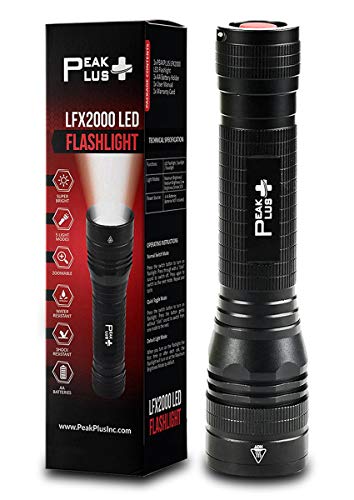
The PeakPlus LFX2000 is a heavy-duty handheld LED flashlight built for homeowners, outdoor enthusiasts, and emergency preparedness planners who need dependable, high-output portable lighting. Designed as a versatile tactical-style torch, it bridges the gap between pocket-sized everyday carry lights and bulky lantern fixtures. It serves as a practical illumination tool for navigating dark backyards, walking pets after dusk, managing roadside tire changes, or keeping on hand for seasonal storm outages.
Lighting performance centers on an output of up to 1200 lumens, producing a strong beam capable of lighting up an entire room or wide outdoor space. The integrated zoomable focus allows users to toggle smoothly between a broad floodlight beam and a narrowed spotlight throw. Supported by five distinct lighting modes, the flashlight lets you adjust your output according to immediate situational demands, whether you need broad area illumination around a campsite or focused distance targeting along an unlit trail.
Build quality focuses on impact resistance and weather defense. The skid-proof, anti-abrasive black exterior provides a secure grip in wet hands or gloved conditions. According to manufacturer specifications, the housing is engineered to withstand drops of up to 10 feet and survive temporary submersion in water, making it a rugged companion in rain, sleet, or rough outdoor environments where delicate consumer flashlights might fail.
Daily operation and power management are straightforward thanks to its four AA battery design (batteries not included). Using disposable or rechargeable AA cells means you never have to wait beside a wall outlet when the power goes out; simply swapping in fresh batteries restores full brightness immediately. Its mid-size footprint balances thermal handling with portability, allowing it to rest neatly inside glove compartments, workshop drawers, or survival packs.
Realistic limitations reflect its traditional battery format. Because the unit does not include an onboard USB charging circuit, users who prefer plug-and-play charging will need to keep a supply of spare AA alkaline or pre-charged NiMH batteries nearby. In addition, runtimes and sustained lumen levels will vary depending on the quality and chemistry of the four AA cells installed.
For shoppers seeking a sturdy, high-lumen handheld LED flashlight that runs on standard, off-the-shelf batteries, the PeakPlus LFX2000 is a reliable and practical choice. Its combination of 1200-lumen output, adjustable focus, water resistance, and heavy-duty impact tolerance makes it an excellent addition to vehicle consoles, home emergency supplies, and camping gear packs.
The PeakPlus LFX2000 utilizes an adjustable optical head to modify its beam distribution on demand. Extending or retracting the bezel alters the focal length, transitioning the light pattern from a wide floodlight to a focused long-range spotlight.
In wide-beam flood mode, the light disperses broadly across an expansive field of view, making it suitable for clearing dark rooms during an outage or inspecting backyards. When adjusted to spotlight mode, the optical system concentrates the 1200-lumen LED output into a tighter beam designed to reach farther down paths, driveways, or wooded trails.
Constructed for demanding environments, the LFX2000 features a heavy-duty chassis with anti-abrasive and skid-proof exterior texturing. This rugged housing is engineered to survive drops from up to 10 feet onto firm surfaces without compromising internal functionality.
The flashlight is also water resistant and rated to survive temporary water submersion, providing dependable operation during heavy downpours, boating trips, or damp emergency scenarios. While suitable for harsh weather exposure, proper care should be taken to ensure the battery compartment seal remains clean and tightly threaded after battery changes.
The PeakPlus LFX2000 is powered by four standard AA batteries, which are not included with the light. This platform is ideal for emergency kits because standard AA cells store easily for long periods without the self-discharge concerns common to unmonitored lithium-ion packs.
Users can operate the flashlight with standard alkaline batteries or compatible rechargeable AA cells. To maintain optimal brightness and prevent sudden power loss during critical events, it is advisable to store a fresh set of spare AA batteries alongside the flashlight in your glove compartment or storm kit.
Defining What Makes a Flashlight Truly Strong
Determining what qualifies as a strong flashlight depends on the baseline standard used to measure visible light output. In everyday consumer lighting, any handheld unit producing between 500 and 1,000 lumens delivers substantial illumination capable of lighting up an entire room or large backyard. Industrial and outdoor search lights often push past 1,000 to 2,000 lumens, while specialized tactical models may advertise outputs well beyond those figures. Evaluating these numbers requires understanding that raw luminous flux represents only a single part of total optical effectiveness.
A strong light must maintain a practical balance between maximum brightness, thermal stability, and manageable power draw. A device that emits 1,500 lumens for two minutes before overheating and stepping down may provide less practical utility than a steady 600-lumen output. True strength combines sufficient luminous flux with optical design that places the light exactly where the user requires it. Knowing how these factors interact helps buyers decipher advertised output numbers without falling for inflated marketing claims.
The Core Lumen Thresholds for High-Output Handheld Lights
Flashlight brightness spans several distinct categories based on operational needs and physical engineering limits. General household flashlights historically produced between 20 and 100 lumens using incandescent bulbs, which established a modest standard for close-range tasks. Modern LED components have raised the bar significantly, making 300 to 500 lumens a standard benchmark for everyday utility. At this level, a beam provides plenty of clarity for navigating dark basements, walking down residential sidewalks, or inspecting plumbing fixtures.
Stepping into the 500 to 1,000 lumen range moves a flashlight into genuinely high-powered territory. Devices operating within this window can cast vivid illumination across open yards, illuminate distant tree lines, and overpower ambient street lighting. The PeakPlus High Powered LED Flashlight LFX2000, for example, lists an output of up to 1200 lumens, demonstrating the substantial visual punch expected in mid-size emergency and outdoor lights. This output level satisfies the majority of demanding tasks, from roadside vehicle repairs to backcountry camping.
Outputs exceeding 1,200 to 2,000 lumens enter the heavy-duty tier, often found in specialized search gear and law enforcement lights. Emitting light at this intensity generates noticeable heat and drains compact power cells rapidly, requiring intelligent driver circuits to manage energy use. While certain promotional lights claim tens of thousands of lumens in tiny hand-held packages, genuine sustained outputs above 2,000 lumens typically demand larger aluminum host bodies with substantial thermal mass. Recognizing these realistic output brackets prevents unrealistic expectations when comparing different models.
Lumens Versus Candela: Why Total Light Differs from Beam Intensity
Understanding flashlight performance requires separating total luminous volume from concentrated beam intensity. Lumens quantify the total amount of visible light emitted by a light source in all directions simultaneously. Candela, on the other hand, measures the luminous intensity of the beam in a specific direction, dictating how brightly the center hotspot shines. Two lights rated at exactly 1,000 lumens can appear completely different depending on their candela measurements and reflector designs.
A high-lumen light with low candela creates a wide flood pattern that illuminates immediate surroundings evenly but fails to penetrate deep into the dark. Conversely, a flashlight with modest lumens paired with high candela produces a tight, piercing spotlight that reaches hundreds of yards while casting minimal spill to the sides. Beam distance ratings according to standard test procedures reflect the point where light drops to the illumination of a full moon, which is 0.25 lux. Relying solely on lumen numbers without considering candela can lead to choosing a light poorly suited for your viewing distance.
Practical tasks dictate which metric should take priority during selection. Indoor home maintenance, electrical repairs, and campsite chores benefit heavily from wide flood beams where high lumen volume prevents tunnel vision. Nighttime perimeter searches, maritime navigation, and trail scouting require high candela to detect obstacles at long range. Evaluating both measurements together gives a complete picture of how the light will perform in real atmospheric conditions.
Thermal Step-Down and the Reality of Sustained Brightness
High-output light emitting diodes generate substantial heat as an inevitable byproduct of converting electrical energy into visible illumination. Compact flashlights rely on their aircraft-grade aluminum alloy bodies to draw thermal energy away from the emitter and disperse it into the air. When an LED operates at maximum output, internal temperatures rise quickly inside the housing. Without protective measures, excessive heat would degrade the diode and damage internal electronic circuits.
Modern high-powered flashlights incorporate thermal regulation circuitry or timed step-downs to prevent thermal runaway. A flashlight advertised at 1,200 lumens may only maintain that peak output for a brief period before automatically lowering brightness to a sustainable level. This regulated level, often ranging between 400 and 700 lumens, represents the true continuous capability of the device. Manufacturers frequently list maximum burst output in their headlines, making it essential to understand that peak lumens are rarely permanent operating modes.
Heavier flashlight housings with deep cooling fins can maintain higher outputs longer than ultralight pocket lights. Ambient environmental conditions, such as cool nighttime air or a steady breeze, also assist passive heat dissipation through the metal body. When planning for extended night activities, relying on medium brightness modes preserves both thermal equilibrium and consistent visibility. Managing output settings manually allows you to access peak bursts when searching a distant tree line without cooking the flashlight during continuous walking.
Optical Systems and Beam Shaping: Flood, Spot, and Zoom Mechanisms
The optical component positioned ahead of the LED determines how raw lumens are organized into a usable visual field. Fixed smooth reflectors create a sharp, distinct center hotspot surrounded by a dimmer spill ring, which favors long-distance throw. Textured orange-peel reflectors soften beam transitions, blending the center hotspot into the periphery for a smoother field of view. Total internal reflection lenses, commonly known as TIR optics, offer precise beam shaping that captures almost all forward light for balanced short and mid-range illumination.
Zoomable flashlights incorporate movable convex lenses that allow the user to manually adjust the focal length of the optical system. Extending or retracting the flashlight bezel shifts the distance between the emitter and the lens, altering the beam angle. The TrixHub Rechargeable Flashlights 2 Pack utilizes this mechanism to transition between wide area flooding and narrow long-distance projection. This adaptability helps users tailor beam distribution on the fly when switching from walking a trail to identifying an object downrange.
Adjustable optical systems do involve minor trade-offs compared to fixed dedicated reflectors. When a zoomable lens extends forward into spotlight mode, some peripheral light is absorbed internally by the housing walls rather than projecting outward. In flood mode, however, these optics distribute light with exceptional uniformity, eliminating harsh central glare that can wash out nearby objects. Selecting between fixed optics and zoomable heads depends on whether you value maximum optical efficiency or operational flexibility across changing tasks.
Power Sources and Voltage Delivery Under High Electrical Load
Producing high lumen output places significant electrical demands on a flashlight power supply. Chemical battery composition, internal resistance, and nominal operating voltage directly govern how much current an LED driver can draw. Standard alkaline AA and AAA batteries exhibit high internal resistance, causing voltage to drop sharply under heavy electrical loads. While alkaline cells offer convenience and widespread availability, they often struggle to support sustained high-output brightness over prolonged durations.
Rechargeable lithium-ion cells provide higher nominal voltage and lower internal resistance, making them the preferred power source for modern high-performance flashlights. These cells sustain steady current delivery under intense loads, allowing the light engine to maintain consistent output without premature dimming. Exploring rechargeable flashlight power practices demonstrates how battery chemistry influences overall illumination stability and long-term ownership value. Units with built-in charging ports streamline power management, eliminating the need to carry external battery cradles during travel.
Certain dual-fuel models accommodate both rechargeable cells and disposable household batteries to maximize versatility in emergencies. The PeakPlus LFX2000 operates on four standard AA batteries, allowing users to pack readily available spares when grid power is unavailable. When considering charging infrastructure, reviewing modern charging methods for portable lights helps ensure your backup power banks and wall adapters meet the voltage input criteria of your equipment. Matching power sources to expected usage conditions guarantees your high-output light will activate whenever darkness strikes.
Matching Light Output and Runtime to Specific Practical Tasks
Selecting an ideal lumen count requires evaluating the physical space and working distance of your routine activities. Navigating inside a darkened house during an outage rarely demands more than 100 to 300 lumens of diffused light. Blasting 1,000 lumens against white drywall creates harsh bounce-back reflection that can temporarily impair night-adapted vision. Moderate settings provide ample situational awareness while preserving hours of continuous battery runtime when utility power remains uncertain.
Outdoor recreational activities introduce wider environments that naturally absorb light, requiring higher brightness levels for safety. Walking a dog along unlit neighborhood streets or following a wooded trail typically benefits from 400 to 800 lumens. This range illuminates immediate footing while casting enough forward throw to spot obstacles, wildlife, or low-hanging branches in time. Flashlights equipped with real-time battery indicators, like the LCD screen on the TrixHub model, allow users to monitor remaining power and adjust brightness before draining the cell.
Specialized search and rescue, property perimeter checks, and agricultural monitoring represent tasks where 1,000 lumens or more become genuinely advantageous. Spotting an animal across an open pasture or scanning a shoreline demands maximum intensity to cut through atmospheric haze. In these demanding scenarios, running a flashlight on high mode for short intervals delivers the needed visual reach while avoiding continuous battery depletion. Structuring your lighting strategy around task distance prevents overspending on unnecessary output while ensuring dependable utility.
Operating Modes and Safe Handling of High-Intensity Portable Beams
Modern high-powered flashlights incorporate stepped multi-mode interfaces to give users precise control over output levels and battery conservation. Standard mode cycles typically progress through low, medium, and high settings, accompanied by specialized strobe or SOS emergency functions. Accessing a low mode of 20 to 50 lumens allows users to read maps or search gear without blinding companions or disturbing sleeping campmates. Specialized emergency signaling modes flash intense bursts to attract attention across vast distances during roadside breakdowns or wilderness distress situations.
Handling intense portable lights requires strict adherence to personal safety precautions to prevent accidental eye damage. Beams producing several hundred to over a thousand lumens can cause flash blindness and temporary retinal afterimages if pointed directly into human or animal eyes. Users should avoid shining high-output lights toward oncoming traffic or reflective glass surfaces where backscatter can impair vision. Teaching family members basic beam discipline ensures powerful lights remain helpful tools rather than unintentional hazards during household use.
Transporting and storing powerful lights also calls for mindful switch management to prevent accidental activation inside bags or pockets. Because high-output LED emitters generate heat rapidly, unintended activation within an enclosed backpack compartment can warm nearby gear. Many tactical-style lights offer mechanical lockouts, where loosening the tailcap slightly breaks electrical contact to prevent unexpected power drain. Proper storage in a dry, temperate environment preserves switch mechanisms, lens coatings, and battery capacity for years of dependable service.
A strong flashlight represents an integrated lighting system where lumen volume, optical focus, thermal control, and battery chemistry operate in harmony. While 500 to 1,200 lumens serves as the practical sweet spot for most demanding personal and outdoor applications, raw numbers alone do not tell the whole story. Verifying beam shape, sustainable runtime, and dependable construction ensures your chosen tool delivers consistent visibility when you need it most.


Write Your Review
No reviews yet. Be the first to share your experience!