


Upgrading Vehicle Visibility on the Road
A burned-out signal bulb often doesn’t get noticed until another driver honks or an erratic clicking alerts your dashboard. Standard miniature bulbs handle critical dual functions like parking markers and rapid flashing, so getting the exact socket match makes a big difference in safety. Selecting the best blinker light bulb requires understanding your vehicle’s specific socket base, whether you need standard dual-filament halogen units or low-draw LED alternatives. A close look at manufacturer specifications reveals that pairing the wrong base code can trigger annoying hyper-flashing errors. Drivers who learn how bulb filaments work can better appreciate how dual-contact pins control both constant running lights and brighter turn pulses.
Halogen models like the 3157 or 4157 offer straightforward plug-and-play simplicity with dependable thermal stability in harsh weather. Modern LED upgrades deliver instant illumination and cooler operating temperatures, but they draw far less wattage than traditional incandescent designs. Based on supplied product specifications, matching the rated voltage and base configuration saves you from loose sockets and moisture damage. Checking your vehicle manual guarantees that your signaling remains crisp and fully street-legal.

Pros
- Direct plug-and-play fit for standard 3157 automotive sockets
- 360-degree beam pattern distributes light evenly across factory vehicle light housings
- Tough quartz glass construction provides heat, shock, and vibration resistance
- Value-focused 10-pack ensures extra backup bulbs for roadside emergencies or home garage inventory
Cons
- Listed luminous flux of 54 lumens represents standard factory output rather than high-intensity output
- Manufacturer-rated life of approximately 500 hours requires periodic replacement compared to long-life solid-state fixtures
- Fixed 3000K warm white color profile does not provide a modern cool-white aesthetic
The CCNU 3157 miniature automotive bulb 10-pack is designed for drivers, DIY mechanics, and fleet managers seeking an affordable, direct replacement for burned-out factory lighting. Built with a dual-level 12V 21/5W electrical rating, this pack matches standard 3157 bulb sockets found across many American sedans, light trucks, SUVs, and passenger vans. Whether addressing a malfunctioning brake indicator or replacing dull turn signals, having a dedicated multipack eliminates emergency auto-parts store trips and simplifies routine vehicle upkeep.
Lighting performance centers on dependable baseline visibility. Operating at a listed output of 54 lumens and a warm white 3000K color temperature, these bulbs emit a smooth 360-degree light distribution. The omnidirectional beam fills vehicle reflector housings evenly without dark spots or beam artifacts, helping trailing drivers recognize brake and turn maneuvers promptly. While not designed for drivers seeking intensely bright auxiliary lighting, the stable output delivers consistent visibility suitable for daily commuting and adverse weather conditions.
Build quality focuses on resisting road harshness. CCNU crafts these miniature bulbs using quartz glass housings paired with reinforced internal filaments and high-grade fill gas. This design provides heat resistance, vibration resistance, and structural shock absorption against potholes and rough pavement. With an estimated manufacturer-rated service life of 500 hours, these bulbs offer practical thermal stability while operating within factory electrical load parameters.
Installation is completely tool-free thanks to the standardized miniature wedge base. Replacing an old bulb involves accessing the rear lighting cluster, twisting the factory socket out, pulling the exhausted bulb, and seating the new 3157 replacement directly into the connector. Because these units operate at the standard 21/5W load on 12-volt vehicle systems, they integrate seamlessly into compatible factory flasher relays and electrical harnesses without requiring aftermarket load resistors.
Potential buyers should keep a few operating boundaries in mind. The 54-lumen output and 500-hour rated lifespan reflect traditional miniature bulb specifications rather than extended-life components. Additionally, vehicle fitment varies by make, model, and year, so checking your vehicle owner manual or inspecting existing bulb markings is essential before purchasing. For drivers who need an economical, exact-fit maintenance supply of standard 3157 bulbs, this 10-piece CCNU set delivers dependable everyday utility.
The CCNU 3157 replacement bulbs feature a standard 12-volt dual-contact wedge base engineered to seat securely into factory automotive 3157 sockets. The 21/5W dual-power specification enables the bulb to serve two brightness levels within the same housing, making it suitable for shared positions like running lights and brake lamps.
These miniature bulbs fit a broad range of vehicles on U.S. roads, including passenger cars, pickup trucks, SUVs, and utility vans. They are compatible with brake lights, turn signals, parking lights, tail lamps, daytime running lights, and reverse sockets that specify standard 3157 sizing. Always confirm your vehicle exact bulb code before ordering to ensure correct fitment.
Each bulb in the CCNU 10-pack produces a manufacturer-listed luminous flux of 54 lumens. This light output is paired with a 3000K warm white color temperature, matching traditional factory lighting aesthetics and providing glare-free, uniform light inside vehicle tail and turn housings.
Thanks to the miniature filament arrangement inside the quartz enclosure, the light disperses in a complete 360-degree pattern. This uniform spread allows vehicle parabolic reflectors to bounce the light outward efficiently, maintaining visibility for trailing motorists and adjacent traffic in night driving and wet weather conditions.
CCNU manufactures these miniature bulbs using high-temperature quartz glass to withstand continuous heat buildup inside compact vehicle light assemblies. The durable glass envelope protects the reinforced filament assembly from premature thermal fatigue and atmospheric degradation.
In addition to thermal resistance, the internal filament supports are optimized to absorb shocks and road vibrations encountered during daily driving. With an estimated operational lifespan of approximately 500 hours, the bulbs offer stable physical durability for regular automotive use.


Frequently Asked Questions
Why does a new LED blinker light bulb cause hyper-flashing on the dashboard?
Yes, hyper-flashing occurs because LED bulbs draw significantly less current than original halogen lamps. The vehicle flasher relay interprets this low electrical draw as a burned-out bulb and flashes rapidly. Based on product details for models like the iBrightstar 3157, adding a 50W 6-ohm load resistor corrects the pulse rate. Verify whether your vehicle requires inline resistors before installation.
Can you use a 3157 bulb in place of a 4157 or 3457 socket?
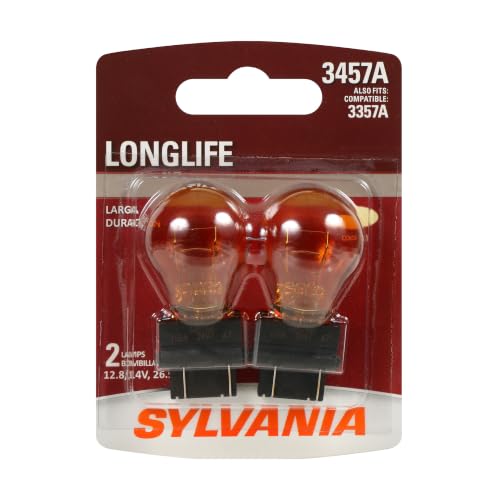
Yes, standard 3157, 4157, and 3457 wedge bulbs share identical base dimensions and physically interchange in most sockets. Manufacturers like SYLVANIA design the 4157 and 3457 with slightly higher major-filament wattage ratings for enhanced daytime brightness. The dual-contact wedge design ensures steady electrical contact across these variants. Checking your vehicle manual confirms the factory wattage tolerance for your exterior light assemblies.
Is an amber bulb required for turn signals, or can you use a white bulb?
No, you should not install a white bulb behind a clear turn signal lens if local regulations require amber signaling. Clear lenses require amber bulbs like the SYLVANIA 4157NA to project the legal amber warning color to oncoming traffic. If your housing features an amber filter, a white bulb shines amber through the colored plastic. Selecting the right combination ensures road visibility.
Why do miniature halogen bulbs generate significant heat inside automotive light housings?
Halogen signal bulbs produce light by heating a tungsten filament, converting most of their electrical energy into radiant heat. While sealed housings withstand normal operating temperatures, poor ventilation can cause excessive heat buildup over time. High-grade quartz glass construction helps manage thermal stress and resists premature filament failure from engine vibration. Replacing bulbs in pairs ensures balanced light output across both assemblies.
What is the 2026 recommendation for selecting the Best Blinker Light Bulb for older trucks and sedans?
The best approach is verifying your exact wedge base number and deciding between long-life halogen reliability or high-output LED efficiency. Traditional long-life halogen bulbs provide dependable plug-and-play service without worrying about dashboard errors or hyper-flashing. If you prefer the instant illumination of modern LEDs, prepare for resistor installation to prevent warning messages. Confirming socket tightness guarantees trouble-free operation on every trip.





Write Your Review
No reviews yet. Be the first to share your experience!